
Navigating Crypto News

CoinFeather
Navigating Crypto News
Quick market read from this story
Sandeep Nailwal's assumption of CEO role at Polygon Foundation signals a strategic pivot towards Polygon PoS and Agglayer, potentially boosting POL's utility and investor confidence.
The discontinuation of the zkEVM project by 2026 and focus on PoS and Agglayer indicates a consolidation of resources and a clearer development path, which could lead to improved transaction performance and new use cases like RWA and stablecoin payments.
The SEC dropping its case against MATIC, coupled with Nailwal's active leadership and plans for POL staker airdrops, creates a more favorable environment for POL price appreciation, contingent on the successful execution of the Agglayer roadmap.
Internal leadership changes and a shift to a more agile, startup-like approach aim to accelerate decision-making and adapt to market dynamics, suggesting a potential for faster innovation and value creation for POL holders.
Deep Dive
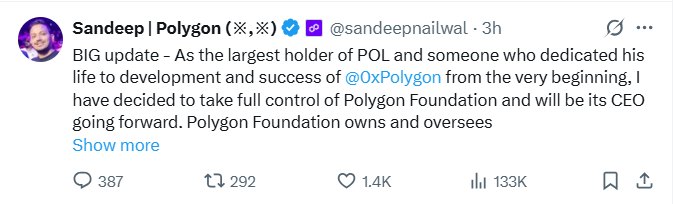
Sandeep Nailwal, a co-founder of Polygon and its largest POL holder, has officially taken over as the CEO of the Polygon Foundation. This move signifies a strategic shift, ending a period of passive involvement to actively steer the ecosystem's core strategy. Nailwal announced his new role via his personal X account, emphasizing the need for a more hands-on approach due to the evolving digital asset landscape and internal changes.
Under Nailwal's leadership, Polygon is set to shut down its zkEVM project by 2026. The foundation will instead concentrate its efforts on the Polygon PoS and the Agglayer network. This strategic pivot aims to enhance transaction performance, with a focus on stablecoin payments and real-world assets. The Gigagas testnet has already launched, targeting 1,000 transactions per second (TPS) by July, with further goals of 5,000 TPS by September and 100,000 TPS in the future. Agglayer v0.3 is scheduled for release on June 30, with fast interoperability expected in Q3. Airdrops are also planned for POL stakers.
Nailwal's assumption of the CEO role follows the departures of several co-founders, including Jaynti Kanani and Anurag Arjun in 2023, and Mihailo Bjelic from the foundation board in May 2025. These exits created a leadership vacuum and, according to Nailwal, slowed decision-making. He aims to adopt a more agile, startup-like approach to enable quicker adaptation to market conditions. This leadership change occurs amidst a broader crypto market upturn, influenced by factors such as Donald Trump's election win in November 2024, which saw Bitcoin reach $109,000 and Ethereum trade around $2,700.
The POL token is drawing renewed attention following these developments. As of the report, POL was trading at $0.2222, experiencing a slight decrease. Market confidence has reportedly improved following the U.S. SEC dropping its case against MATIC, leading to increased liquidity. Nailwal's roadmap, focusing on improved TPS, Agglayer updates, and staker airdrops, could potentially boost the token's value if executed effectively. The upcoming release of Agglayer v0.3 on June 30 is seen as a critical test for the new leadership's ability to drive the POL price forward.
Source, catalyst, and sector overlap from the latest feed.
Crypto donations are showing steady growth, crossing $100 million in 2025 and a 66% rise from the previous year, indicating increasing adoption beyond experimental use. While crypto giving is expanding, it has not yet become a significant part of seasonal donation trends like Easter, suggesting it remains a niche area despite overall growth. The IRS guidance on crypto donations, particularly regarding tax deductions based on holding periods, provides clarity that may encourage more donors to utilize digital assets for charitable contributions.
Upcoming CPI data and FOMC minutes are poised to introduce significant volatility into the crypto market, as these macroeconomic indicators will heavily influence interest rate expectations. Traders should monitor the March CPI report on April 10th for inflation trends, as higher-than-expected figures could trigger selling pressure, while lower figures may support price appreciation. The release of FOMC minutes on April 8th will provide insight into the Federal Reserve's monetary policy stance, with a dovish outlook potentially benefiting crypto prices and a hawkish one posing a risk. Anticipate potential liquidity shifts and trading activity fluctuations due to major token unlocks scheduled for the upcoming week.
Metaplanet's aggressive Bitcoin accumulation, now exceeding 40,000 BTC and reaching 40% of its 2026 target, positions it as a significant corporate holder and signals strong conviction in Bitcoin's long-term value despite short-term volatility. The company's stock trading at a discount to its Net Asset Value (NAV) suggests potential undervaluation, presenting a buying opportunity for investors who believe in its Bitcoin treasury strategy and future growth. Metaplanet's strategic investments beyond direct BTC holdings, including JPYC and Bitcoin Magazine licensing, indicate a broader ecosystem play aimed at capturing value across Asian markets and potentially influencing Bitcoin adoption. The comparison to MicroStrategy highlights Metaplanet's rapid accumulation velocity, suggesting it could become a dominant player in the corporate Bitcoin treasury space, especially in Asia, which may lead to increased market attention and potential price appreciation.
Metaspins is positioning itself as a leading Web3 crypto casino by emphasizing high RTP games, provably fair technology, and fast-paced gameplay, aiming to attract crypto enthusiasts seeking transparent and engaging online gaming experiences. The platform's focus on proprietary 'Originals' like Plinko, Mines, and Keno, which offer high RTP (up to 99%) and strategic elements, suggests a strategy to differentiate from traditional online casinos and capture market share within the growing Web3 gaming sector. By integrating crypto payments and a user-friendly interface across devices, Metaspins is leveraging blockchain technology to enhance convenience and trust, signaling a broader trend of crypto adoption in the online entertainment industry.
MicroStrategy's resumption of Bitcoin purchases with a $330 million acquisition signals continued institutional conviction, potentially bolstering market sentiment for BTC. The MSTR stock's 4% gain following the announcement indicates a direct positive correlation between MicroStrategy's BTC accumulation and its equity performance, offering a proxy trade for Bitcoin exposure. With MicroStrategy holding over 766,000 BTC, its ongoing accumulation strategy remains a significant factor influencing Bitcoin's supply dynamics and market perception. The company's substantial $42 billion ATM facility highlights its aggressive future acquisition plans, suggesting sustained demand pressure on Bitcoin from a major corporate buyer.
US House members are questioning the CFTC's oversight of insider trading on prediction markets, signaling potential regulatory scrutiny that could impact platforms like Kalshi and Polymarket. While the CFTC affirmed its authority over prediction markets, concerns about "morally obscene" event contracts and suspicious trades suggest a heightened risk of regulatory action or new legislation. The ongoing legal battles and congressional inquiries into prediction markets indicate a developing regulatory landscape that traders should monitor closely for potential impacts on market access and operation.
Prosecutors are pushing back against Tornado Cash developer Roman Storm's attempt to use a recent Supreme Court ruling for dismissal, arguing it is not applicable to his case. The DOJ's stance highlights a continued aggressive prosecution of crypto developers despite some signals of a more favorable stance from the Trump administration. The legal battle underscores the ongoing tension between crypto privacy advocacy and regulatory enforcement, with potential implications for other developers in similar situations. The rejection of Storm's argument suggests the retrial will proceed, focusing on charges of conspiracy to commit money laundering and sanctions evasion.
The FBI's report highlights a significant increase in crypto fraud, with over $11.2 billion lost in 2025, indicating a persistent threat to investor capital and market integrity. Investment fraud, particularly "pig butchering" schemes and fake exchanges, is the primary driver of these losses, underscoring the need for enhanced user education and platform security measures. The FBI's successful freezing of over 3,000 illicit wallets and recovery of $500 million demonstrates the effectiveness of public-private collaboration and on-chain analytics in combating crypto crime. The increasing use of AI in cybercrime, contributing nearly $893 million in losses, signals a new frontier of threats that will require adaptive security strategies and regulatory oversight.
The FDIC's proposed rule for stablecoin issuers, aligned with the GENIUS Act, introduces capital, liquidity, and custody standards, signaling a move towards formal regulatory frameworks for the sector. The proposal clarifies that stablecoins will not receive deposit insurance, a key distinction from traditional bank accounts, impacting how market participants perceive their safety and yield potential. While the FDIC's proposal addresses potential concerns around yield programs, it aims to prevent misrepresentation of interest or yield solely from holding payment stablecoins, requiring careful structuring of rewards. The FDIC's move to solicit public comment on 144 questions indicates a thorough regulatory process, suggesting that final rules may take time to implement, creating a period of regulatory uncertainty for issuers.
US prosecutors are pushing back against Tornado Cash co-founder Roman Storm's defense arguments, indicating a continued legal battle that could set precedents for developer liability. The rejection of Storm's motion for dismissal suggests prosecutors are determined to pursue charges related to money laundering and sanctions violations, potentially leading to a retrial. The ongoing legal proceedings for Tornado Cash highlight the evolving regulatory landscape and the risks developers face when creating open-source code used in decentralized applications.
Geopolitical de-escalation via a U.S.-Iran ceasefire has triggered a significant risk-on sentiment, driving Bitcoin above $72,000 and boosting other risk assets. The ceasefire announcement led to a collapse in oil prices, alleviating inflation fears that had previously capped Bitcoin's upside and pressured traders into bearish positions. Liquidation of nearly $600 million in leveraged crypto futures, predominantly short bets, indicates strong bullish momentum and a potential short squeeze, reinforcing upward price pressure.
Geopolitical de-escalation between the USA and Iran triggered a significant risk-on rally in crypto markets, with Bitcoin and Ethereum experiencing notable price increases. The surge was amplified by substantial short liquidations, indicating that a portion of the price action was driven by forced covering rather than purely organic buying pressure. While the broader market benefited from the ceasefire news, Zcash exhibited unusual outperformance, suggesting independent project-specific catalysts are at play. The market's rapid repricing highlights crypto's sensitivity to macro inflection points and embedded leverage, with potential for swift reversals if geopolitical tensions re-emerge.
Solana DEX Stabble urged users to withdraw liquidity due to a former CTO's alleged ties to North Korean hackers, causing a 62% drop in TVL. The incident highlights ongoing security concerns within the DeFi space, particularly concerning state-sponsored hacking groups. While no exploit occurred on Stabble, the rapid TVL decline underscores user sensitivity to perceived security risks, especially following recent large-scale exploits on Solana. The Solana Foundation's recent security initiatives may be tested by such events, indicating a continued need for robust security measures across the ecosystem.
Bitcoin long-term wallets have absorbed over 4.37 million BTC, indicating sustained supply reduction and a potential precursor to a bull market phase. The Bitcoin network activity index has entered a 'bull phase,' signaling increased network usage and potentially stronger market sentiment. Reduced inflows from centralized exchanges and a decrease in active addresses suggest a shift towards long-term holding, tightening liquid supply and reducing short-term trading pressure. Despite low active address momentum, historical patterns suggest this can align with profitable accumulation phases for long-term holders.
SpaceX's potential IPO, targeting a $1.75 trillion valuation and possibly using the $SPCX ticker, signals significant institutional interest and a major liquidity event for the aerospace sector. The planned extensive retail investor allocation, potentially up to 30%, suggests a strategy to leverage community support and could set a precedent for future large-cap IPOs, impacting broader market sentiment towards direct retail participation. The emergence of leveraged ETF filings tied to SpaceX stock post-listing indicates anticipation of significant price volatility and provides a potential avenue for speculative trading strategies around the IPO event.
Live Feed
Loading the broader stream in the same flow as the homepage feed.
Check back shortly for newer market coverage.
Signal context only. Validate with price action, liquidity, and risk limits before taking a position.
