
Navigating Crypto News

CoinFeather
Navigating Crypto News
Quick market read from this story
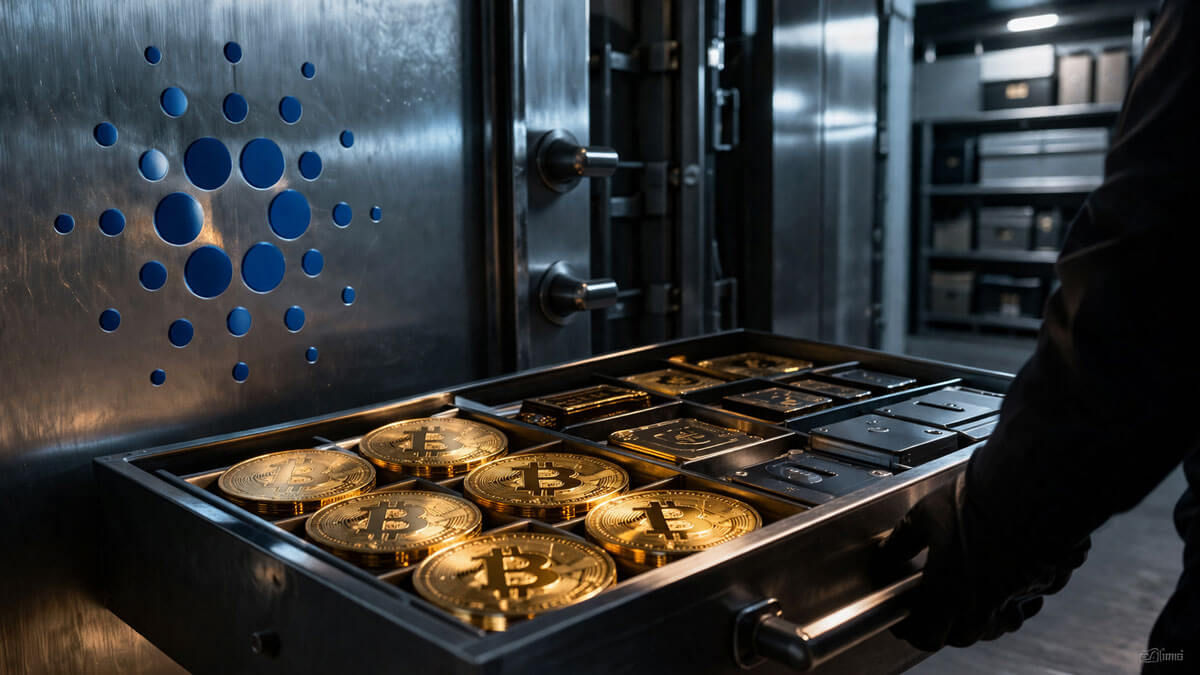
The Cardano Foundation's strategic shift to diversify its treasury away from ADA towards Bitcoin and cash signals a reduced direct financial linkage to ADA's price performance, potentially altering internal alignment and feedback loops.
A significant decrease in ADA holdings from 76.7% to 51.6% of the Cardano Foundation's reserves, coupled with an increase in Bitcoin and cash, indicates a strategic de-risking and a move towards a more diversified treasury management approach.
The Foundation's increased focus on technology, adoption, and governance spending, including initiatives in digital identity and RWA, suggests a strategic pivot to bolster Cardano's ecosystem infrastructure and attract institutional interest, independent of ADA's direct price action.
Deep Dive
The Cardano Foundation has significantly reduced its reliance on its native token, ADA, with Bitcoin and cash now comprising a much larger portion of its reserves. This strategic shift, detailed in the Foundation's 2025 Activity and Financial Insights Report, comes after a year of sharp price divergence between ADA and other assets. The Foundation's total assets declined by 45% to 287.5 million Swiss francs (approximately $361 million) by the end of 2025, down from $659.1 million at the end of 2024.
A year prior, ADA constituted 76.7% of the Foundation's assets, with Bitcoin at 14.9% and cash/equivalents at 8.3%. By the end of 2025, this allocation had shifted dramatically: ADA's share fell to approximately 51.6%, while Bitcoin's share rose to 25.5%, and cash, cash equivalents, and financial assets increased to 22.9%. This translates to roughly $186 million in ADA, $92 million in Bitcoin, and $83 million in cash and financial assets.
Interestingly, Bitcoin's increased share in the portfolio was not due to an accumulation of more BTC. The Foundation actually reduced its BTC holdings by 37%, from 1,054 BTC to 656 BTC. The shift in percentage was driven by the relative performance of assets; ADA experienced a roughly 63% decline over the year, while Bitcoin showed more resilience, declining by around 25%. This divergence allowed Bitcoin to claim a larger share of the treasury despite a decrease in the absolute amount held.
The Foundation's treasury is becoming more layered, with increased use cases for Bitcoin and expanded cash holdings. Part of the Bitcoin allocation was invested in loans and collective investment schemes. Financial assets, including loans, investments, and shares, grew to 43.9 million Swiss francs ($54.9 million) from 14.3 million Swiss francs ($17.8 million) the previous year. Cash and cash equivalents stood at 20.1 million Swiss francs ($25.1 million). This indicates a move towards a more diversified and actively managed reserve base beyond just ADA and Bitcoin.
Spending in 2025 was re-aligned across three strategic pillars: technology, adoption, and governance, totaling 23.6 million Swiss francs ($29.5 million). Technology received the largest share at 40.3% (9.5 million francs), followed by adoption at 39.6% (9.3 million francs), and governance at 20.1% (4.8 million francs). This contrasts with 2024's focus on adoption, operational resilience, and education, signaling a sharper direction for resource allocation.
Technology spending focused on protocol enablement, developer tooling, and interoperability. Adoption efforts included enterprise solutions, identity systems, and ecosystem partnerships, notably with the launch of Veridian, a privacy-preserving identity platform. The Cardano Academy also expanded its reach through partnerships with Binance Academy, the Blockchain Research Institute, and Coursera.
Governance spending supported decentralized decision-making, including on-chain budget proposals and participation in various committees. Initiatives included work on the constitutional process, the Cardano 2030 vision, and support for governance tools like the Cardano Voting Tool. The DRep Delegation Program distributed significant ADA allocations to support builders and governance participants.
Looking ahead to 2026, the Cardano Foundation plans to maintain its focus on technology, governance, and enterprise adoption. Key areas include strengthening Cardano's role in real-world asset infrastructure, supporting DeFi liquidity and stablecoin markets, and developing open-source tooling. These efforts align with recent integrations with networks like Pyth, LayerZero, and Circle's USDCx, aimed at expanding Cardano's DeFi ecosystem and attracting institutional support. The success of this repositioning and increased spending on infrastructure, governance, and adoption will be crucial in stabilizing the economics around ADA.
Source, catalyst, and sector overlap from the latest feed.
Bitcoin is holding near $68,000, demonstrating resilience despite escalating geopolitical tensions and a surge in oil prices, indicating underlying spot buying pressure rather than leveraged speculation. The market is currently driven by external geopolitical events, specifically the US-Iran conflict and its impact on oil prices, rather than internal crypto catalysts, creating a fragile trading environment. Negative funding rates suggest that short sellers are still paying to maintain bearish positions, which could fuel a sharper upward move if Bitcoin breaks through resistance and triggers liquidations. Bitcoin's price action is highly sensitive to geopolitical developments, with a narrow trading range between $65,000 and $70,000 amplifying potential short-term volatility based on US-Iran relations.
Polymarket's introduction of its own stablecoin, Polymarket USD, backed 1:1 by native USDC, does not directly reduce USDC's market cap as it represents a rebranding of collateral rather than a withdrawal of funds. The shift from USDC.e to Polymarket USD on the platform streamlines user experience and gives Polymarket greater control over its collateral and yield economics, reducing reliance on bridged assets. This development highlights a growing trend of layered stablecoin ecosystems where platform-specific tokens interface with users, while underlying assets like USDC serve as foundational collateral, making market analysis more complex. While not a direct threat to USDC's market cap, the structural change introduces new dependencies on Polymarket's redemption design and operational controls, adding a layer of risk for users.
XRP is exhibiting capitulation behavior with long-term holders realizing significant daily losses, indicating selling pressure driven by risk reduction rather than profit-taking. Despite positive developments in Ripple's legal standing and business expansion, XRP's price action is characterized by a fragile structure due to underwater buyers and defensive leveraged traders, preventing durable recoveries. While spot markets show continued demand, the negative sentiment in XRP's derivatives market and recent ETF outflows suggest a lack of conviction for a near-term trend reversal, keeping the asset in a state of suspension.
The departure of key Aave contributors (BGD Labs, ACI, Chaos Labs) creates a significant operational void, potentially impacting Aave's risk management and governance execution during the critical V3/V4 transition. Aave Labs is consolidating functions previously handled by external teams, aiming for faster execution and clearer responsibility, but faces the challenge of replicating the operational density of the previous federated model. Despite contributor exits, Aave's strong market position in DeFi lending, evidenced by its TVL and stablecoin dominance, provides a structural resilience, though a second operational incident could erode confidence. The recent wstETH liquidation event, though minor in financial terms, highlights the operational risks during the V3/V4 overlap and underscores the importance of Aave Labs successfully managing the new integrated structure.
The SEC's decision on intermediary definitions for tokenized stocks will determine whether blockchain innovation primarily benefits incumbents or opens new revenue streams for decentralized infrastructure like wallets and smart contract platforms. A ruling favoring Citadel Securities' broad interpretation of intermediaries could keep tokenized equities within traditional financial wrappers, limiting disruption and preserving existing fee structures. Conversely, adopting the Blockchain Association's narrower, function-based view could foster competition by allowing decentralized applications to capture value, potentially accelerating broader adoption of on-chain equity trading. The current $946 million tokenized stock market serves as a test case, with the SEC's framework poised to shape the future control and economic distribution of a potentially trillion-dollar asset class.
Geopolitical de-escalation via a U.S.-Iran ceasefire has triggered a significant risk-on sentiment, driving Bitcoin above $72,000 and boosting other risk assets. The ceasefire announcement led to a collapse in oil prices, alleviating inflation fears that had previously capped Bitcoin's upside and pressured traders into bearish positions. Liquidation of nearly $600 million in leveraged crypto futures, predominantly short bets, indicates strong bullish momentum and a potential short squeeze, reinforcing upward price pressure.
Geopolitical de-escalation between the USA and Iran triggered a significant risk-on rally in crypto markets, with Bitcoin and Ethereum experiencing notable price increases. The surge was amplified by substantial short liquidations, indicating that a portion of the price action was driven by forced covering rather than purely organic buying pressure. While the broader market benefited from the ceasefire news, Zcash exhibited unusual outperformance, suggesting independent project-specific catalysts are at play. The market's rapid repricing highlights crypto's sensitivity to macro inflection points and embedded leverage, with potential for swift reversals if geopolitical tensions re-emerge.
Solana DEX Stabble urged users to withdraw liquidity due to a former CTO's alleged ties to North Korean hackers, causing a 62% drop in TVL. The incident highlights ongoing security concerns within the DeFi space, particularly concerning state-sponsored hacking groups. While no exploit occurred on Stabble, the rapid TVL decline underscores user sensitivity to perceived security risks, especially following recent large-scale exploits on Solana. The Solana Foundation's recent security initiatives may be tested by such events, indicating a continued need for robust security measures across the ecosystem.
Bitcoin long-term wallets have absorbed over 4.37 million BTC, indicating sustained supply reduction and a potential precursor to a bull market phase. The Bitcoin network activity index has entered a 'bull phase,' signaling increased network usage and potentially stronger market sentiment. Reduced inflows from centralized exchanges and a decrease in active addresses suggest a shift towards long-term holding, tightening liquid supply and reducing short-term trading pressure. Despite low active address momentum, historical patterns suggest this can align with profitable accumulation phases for long-term holders.
SpaceX's potential IPO, targeting a $1.75 trillion valuation and possibly using the $SPCX ticker, signals significant institutional interest and a major liquidity event for the aerospace sector. The planned extensive retail investor allocation, potentially up to 30%, suggests a strategy to leverage community support and could set a precedent for future large-cap IPOs, impacting broader market sentiment towards direct retail participation. The emergence of leveraged ETF filings tied to SpaceX stock post-listing indicates anticipation of significant price volatility and provides a potential avenue for speculative trading strategies around the IPO event.
Live Feed
Loading the broader stream in the same flow as the homepage feed.
Check back shortly for newer market coverage.
Signal context only. Validate with price action, liquidity, and risk limits before taking a position.
