
Staking Sector News
Latest Staking stories with sentiment, impact, and action bias for active crypto traders.
Context filters
Narrow this sector stream by time window.

Why Everyone Is Watching Pepeto as Bitcoin Starts Front-Running the Fed and the Next Bull Run Builds
Bitcoin's shift to front-running Fed decisions, driven by ETF flows, signals a fundamental change in its market behavior, moving from a reactive asset to a forward-looking indicator for the broader crypto market. The emergence of Pepeto as a highly watched presale, backed by a former Pepe co-founder and offering pre-launch exchange tools and audits, suggests a potential for significant upside in early-stage meme coins during this market cycle. While Bitcoin and ETH show steady but range-bound price action, the substantial capital raised and high APY staking offered by Pepeto highlight a trader rotation towards high-potential presale opportunities seeking outsized returns.

What Every ETH Holder Should Know After the Drop Below $2,100 and the Opportunity Taking Shape
Institutional accumulation of ETH, exemplified by BitMine's $143 million purchase and the Ethereum Foundation's shift to staking, signals growing confidence in ETH as a yield-bearing asset, potentially reducing sell pressure and supporting long-term price appreciation. The article highlights a contrast between institutional ETH accumulation and retail observation during a market downturn, suggesting a potential opportunity for informed investors to enter positions before broader market recovery. Pepeto's successful $8.68 million funding round during a period of market fear, coupled with a confirmed Binance listing and a working product, presents a high-risk, high-reward scenario that traders may consider for compressed returns, distinct from ETH's slower institutional yield-driven growth.

Top 10 DeFi Protocols by Development Activity in the Past Month
Chainlink's successful pilot with Swift and major banks on CCIP signals a significant step towards integrating traditional finance with tokenized assets, potentially unlocking new institutional capital flows. Aave V4's launch with a modular architecture and institutional interface, alongside Lido's capital management strategies and Injective's deflationary tokenomics, highlight divergent but impactful development paths within the DeFi sector. The potential for native Bitcoin to be used as collateral in DeFi lending via Babylon Labs' integration with Aave V4 represents a structural shift, bridging the largest crypto asset with decentralized finance and enhancing capital efficiency. The ongoing development activity across top DeFi protocols, from infrastructure upgrades to tokenomic adjustments and institutional product launches, indicates a maturing ecosystem with varied strategies for growth and adoption.
Zcash Price Moves Higher, Chainlink Consolidates, and BlockDAG Remains in Presale Phase at $0.000022
Zcash is approaching a key resistance level at $260, with increased trading volume suggesting potential for further upside if the $250 level holds. Chainlink (LINK) is consolidating between $8 and $10, indicating a neutral short-term outlook with a need for new catalysts to drive significant price movement. BlockDAG (BDAG) is in its presale phase at $0.000022, reporting substantial on-chain activity and network performance metrics that could signal future growth upon market entry.

Tom Lee’s BitMine Nears 4% of Ethereum Supply as ETH Price Hits Weekly High
BitMine's significant accumulation of ETH, now holding nearly 4% of the circulating supply, signals strong conviction from a major institutional player, potentially influencing market sentiment and demand. The firm's chairman, Tom Lee, highlights ETH's resilience and potential to attract capital, suggesting a bullish outlook driven by Wall Street tokenization and AI integration, which could support further price appreciation. With 69% of its ETH holdings staked, BitMine is positioned to generate substantial annual revenue from staking rewards, indicating a strategic focus on yield generation that could be emulated by other large holders.
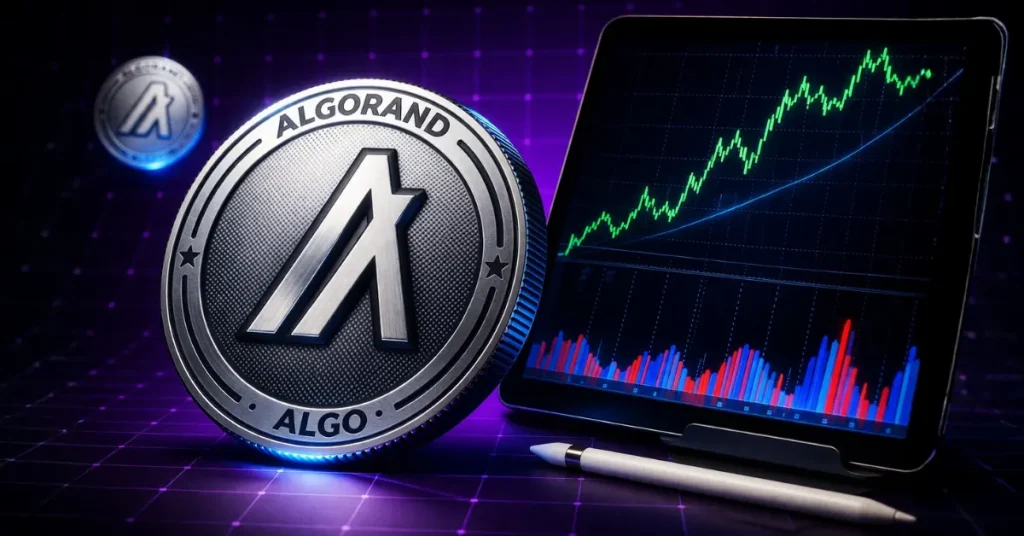
Algorand Price Prediction: 3 Key Catalysts That Point to $0.50
Algorand's recent 47% price surge is underpinned by three significant catalysts: Google's recognition of its post-quantum security, Revolut's integration enabling staking for 70 million users, and SEC/CFTC classification as a digital commodity, which clarifies institutional engagement. The classification of ALGO staking as an administrative act rather than an investment contract by the SEC and CFTC removes a key institutional barrier, potentially unlocking significant capital inflow and demand. Increased open interest in ALGO futures and a bullish long/short ratio suggest derivatives traders are anticipating further price appreciation, with analysts targeting $0.20 and potentially $0.50.

BlockDAG, BNB, XRP, and Dogecoin: Market Overview of Selected Crypto Assets in 2026
BlockDAG is poised for public trading on April 8th, with initial reports of significant on-chain activity and a high transaction processing capacity, suggesting potential early investor interest. BNB's utility within its ecosystem, coupled with its token burn mechanism, continues to support demand, while XRP's focus on cross-border payments and Dogecoin's established presence highlight diverse market roles. The article serves as a sponsored overview of selected crypto assets, emphasizing the need for individual research due to the inherent volatility and speculative nature of the market.

Crypto Price Prediction April 2026: SOL, ADA, Price Targets Might Be Shocking While Pepeto Nears Listing
The Solana network faces significant headwinds following a $280 million Drift protocol exploit, which has negatively impacted SOL's price and investor confidence, suggesting a cautious outlook for the Layer 1 blockchain. Cardano's price continues to struggle, trading significantly below its all-time high and showing limited recovery potential in the near term, exacerbated by the Cardano Foundation's decision to move reserves out of ADA. Pepeto is being positioned as a high-potential presale opportunity, drawing parallels to Pepe's past success, with claims of significant funding, strong staking APY, and an upcoming exchange listing that could drive substantial price appreciation. The current market sentiment is characterized by 'extreme fear,' with major cryptocurrencies like Solana and Cardano experiencing price drops, while attention shifts to presale opportunities like Pepeto that promise outsized returns.

SUI Tests $1.05 While Pepeto 300x Heats Up As Project Hits CoinMarketCap Before Binance Listing
Pepeto is positioned as a potential high-return opportunity due to its upcoming Binance listing and presale pricing, contrasting with SUI's slower recovery trajectory. The article highlights a market information gap for retail traders, with Pepeto aiming to provide tools for early positioning before institutional moves, suggesting a potential shift in retail trading dynamics. While SUI faces resistance and requires broader market recovery, Pepeto's confirmed listing and presale offer a more immediate, albeit higher-risk, potential for rapid gains, appealing to traders seeking quick returns. The comparison between SUI's consolidation and Pepeto's imminent listing and presale suggests a divergence in near-term market opportunities, favoring projects with clear, near-term catalysts.

Ethereum at a Crossroads: Institutional Money Moves In While Price Stalls Near $2,000
Institutional adoption is accelerating with Charles Schwab opening a waitlist for direct ETH spot trading, signaling a shift away from indirect exposure like ETFs and potentially unlocking access for millions of retail clients. Significant corporate accumulation of ETH by Bitmine Immersion Technologies and a strategic shift by the Ethereum Foundation to stake rather than sell ETH are creating structural demand and reducing sell pressure, despite current price stagnation. While on-chain metrics and institutional interest suggest underlying strength, ETH's price action and technical indicators remain neutral-to-bearish, highlighting a divergence that warrants close observation of future demand catalysts. Upcoming Ethereum protocol upgrades in 2026, including Glamsterdam and Hegota, aim to significantly enhance scalability and decentralization, laying the groundwork for future network growth and adoption.

Ethereum Price Eyes $2.2K Breakout as Foundation Stakes $46.6M ETH
Ethereum price is showing signs of stabilization and potential upward momentum, with analysts targeting a breakout above $2.1K and $2.2K if key resistance levels are held. The Ethereum Foundation's significant staking of $46.64M in ETH signals a strong conviction in the network's long-term value and a reduced immediate selling pressure from a major holder. Increased whale balances and decreasing small wallet balances suggest a potential shift in accumulation patterns, which could precede a price rally if confirmed by broader market sentiment.

Digital asset treasuries must now earn their keep
The market is signaling that passive accumulation of digital assets is no longer sufficient for corporate treasuries, shifting focus to active yield generation and capital discipline. Emerging strategies for digital asset treasuries include infrastructure participation and staking, active trading and market-driven income, and credit deployment via borrowing against holdings. Companies with digital asset exposure will increasingly be valued on their ability to generate sustainable income, moving beyond simple price appreciation as a measure of maturity. The most resilient treasuries may be those that diversify income sources, potentially blending crypto-native yields with traditional finance strategies or even AI compute services.

Ethereum Exchange Balances Fall to All-Time Lows – What You Need to Know
Ethereum exchange balances have reached an all-time low of 10.969%, indicating a significant supply contraction as holders move assets off exchanges, likely for staking or cold storage. The Ethereum Foundation's completion of its 70,000 ETH staking target signifies a shift from a selling model to direct network participation, enhancing operational legitimacy despite not solving funding needs. The divergence in holding behavior between ETH (staking) and BTC (cold storage) suggests a market repricing of Ethereum as infrastructure with a yield and governance function, rather than purely a speculative asset. The technical feasibility of the Ethereum Foundation's solo-staking move was enabled by EIP-7251, which raised the effective validator balance limit, making large-scale staking more manageable.

Ethereum Just Flashed a Rare Signal: What Happens Next?
Ethereum's exchange supply has fallen to multi-year lows, indicating a significant reduction in liquid supply available for sale. Emerging buy-side pressure in derivatives markets, coupled with tightening supply, suggests a potential breakout setup for ETH, awaiting confirmation. The current price compression beneath a key trendline at approximately $2,100-$2,200 presents an inflection point, with a decisive move expected based on breakout confirmation.

Ethereum News: Foundation Nears 70K ETH After $92M Stake Push
The Ethereum Foundation's increased ETH staking activity signals a strategic shift towards yield generation, potentially reducing future sell pressure and supporting network economics. This move by the Ethereum Foundation to stake nearly 70,000 ETH highlights a broader trend of crypto organizations prioritizing on-chain yield over asset liquidation for treasury management. While the staking strategy aims for financial sustainability, it also raises governance questions regarding potential influence concentration, a point previously flagged by Vitalik Buterin. The Foundation's adoption of a yield-based treasury model reinforces Ethereum's narrative as a productive, yield-bearing asset, potentially attracting further capital to the ecosystem.
Vitalik Buterin Has Been Selling ETH: Who Is Ethereum's 2026 Top Holder?
Vitalik Buterin's ongoing ETH sales, exceeding initial targets, signal continued commitment to funding open-source and ecosystem development, but the transparent nature of these sales mitigates significant market disruption. While Buterin remains a top individual ETH holder with accessible funds, the Beacon Deposit Contract and major exchanges/ETFs represent far larger concentrations of ETH, highlighting the layered ownership structure of Ethereum. The article provides a detailed breakdown of ETH ownership, emphasizing that institutional adoption via ETFs like BlackRock's is increasingly shaping the supply map, alongside exchange reserves and staking contracts.

$126 Million in LINK Hits Binance as Chainlink Completes Quarterly Unlock
A significant quarterly unlock of 14.9 million LINK tokens, valued at approximately $126 million, has been transferred to exchanges, with a substantial portion landing on Binance. The timing of the transfer to Binance on a weekend with lower liquidity raises concerns about potential selling pressure, as large holders may use this window to distribute tokens with less immediate price impact. While part of the unlocked tokens are designated for staking rewards, the large inflow to Binance introduces uncertainty, making the 50-day SMA at $8.64 a critical level to monitor for potential downside price action. The market's interpretation of this large inflow hinges on whether the tokens are for operational purposes or immediate sale, with the 50 SMA acting as a key technical indicator for near-term price direction.

Chainlink Unlocks 19M LINK, $165M Moved to Market
Chainlink completed its routine quarterly token unlock, releasing 19 million LINK tokens valued at approximately $165 million, with a significant portion directed to Binance, indicating potential short-term selling pressure. Despite the unlock and transfer of tokens to exchanges, LINK's price has remained relatively stable, suggesting that the market may have already priced in this regular event or that underlying demand is absorbing the supply. The simultaneous increase in large holders (whales) accumulating LINK, alongside the quarterly unlock, presents a mixed signal, potentially indicating a strategic accumulation phase by larger players despite increased circulating supply.

Ethereum Foundation nearly reaches 70,000 staked ETH goal
The Ethereum Foundation's near-completion of its 70,000 ETH staking goal signifies a strategic shift towards yield generation for ecosystem funding, potentially reducing reliance on token sales and signaling confidence in ETH's long-term value. The EF's increased participation in staking and DeFi, as outlined in their treasury policy, suggests a growing integration with the core Ethereum ecosystem's financial infrastructure, aiming to support development and grants through generated yield. Vitalik Buterin's caution regarding the Ethereum Foundation's staking potentially forcing positions in contentious hard forks highlights a subtle centralization risk that the EF is actively exploring mitigation strategies for, a point of interest for network governance discussions.

Ethereum Foundation Stakes $93M Worth of ETH, Nears Strategic Target
The Ethereum Foundation's significant ETH staking activity, nearing its 70,000 ETH target, signals strong conviction in Ethereum's proof-of-stake security and long-term value appreciation. This substantial commitment to staking, representing a strategic treasury management decision, is likely to be interpreted by the market as a vote of confidence, potentially supporting ETH's price by reducing sell pressure and reinforcing network security. The projected annual staking rewards of $4-5 million highlight the economic sustainability of Ethereum's PoS model and the Foundation's strategy to generate yield from its holdings.

