
Navigating Crypto News

CoinFeather
Navigating Crypto News
Quick market read from this story
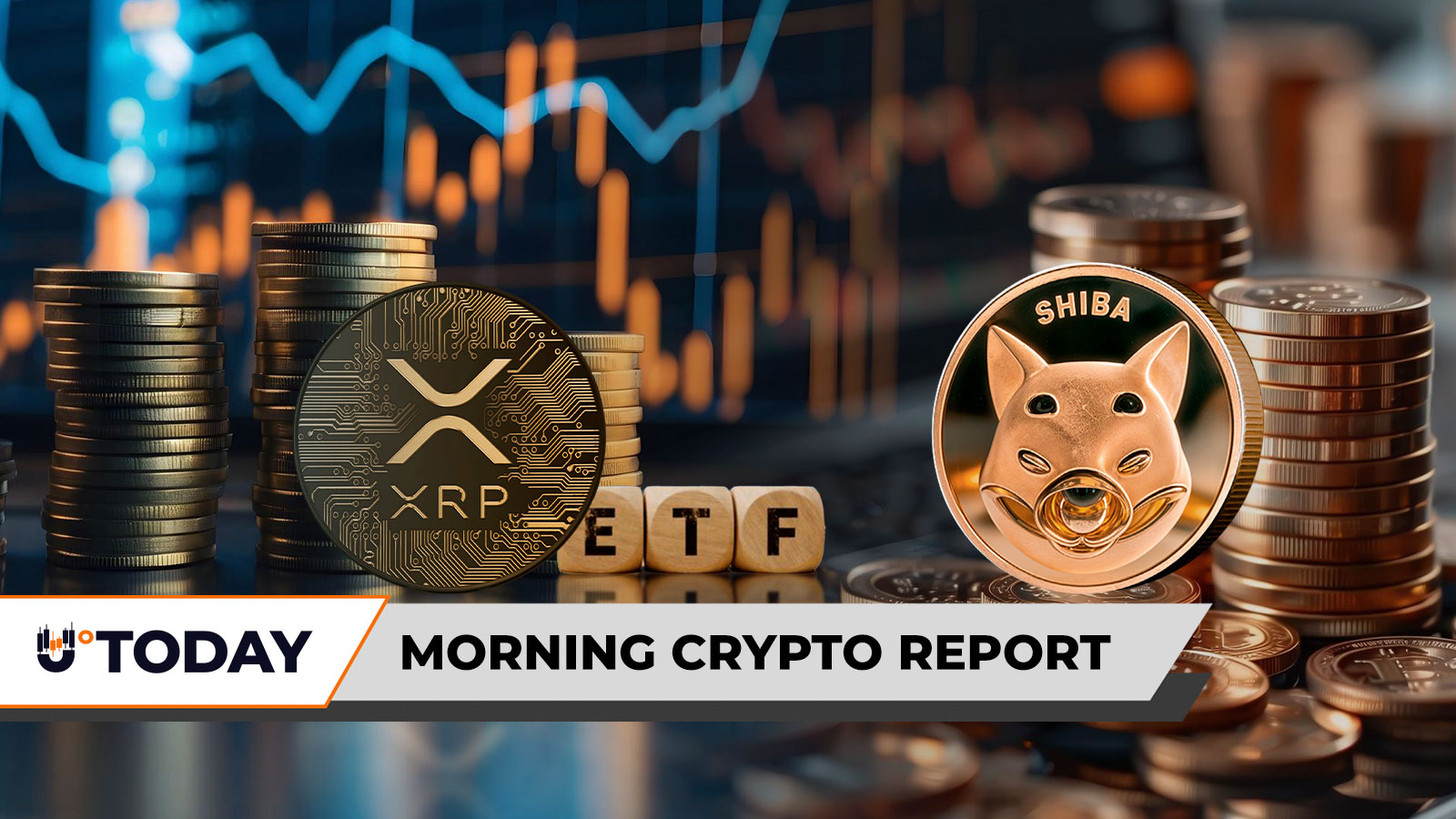
XRP faces significant liquidation risk near $1.35 ahead of a crucial SEC ETF verdict, suggesting potential for sharp price movements driven by leveraged traders.
Massive SHIB outflows from exchanges indicate potential whale accumulation and a supply squeeze, historically preceding price rallies.
The listing of Tether Gold (XAUt) on Binance with a Seed Tag expands its accessibility and highlights its growing presence in the tokenized asset market.
Bitcoin's price action is currently dominated by a large options expiration, creating potential for volatility as traders position themselves ahead of Friday's event.
Deep Dive
The cryptocurrency market is experiencing significant volatility as XRP nears a critical liquidation level ahead of a key SEC decision, Shiba Inu (SHIB) witnesses substantial whale accumulation, and Tether Gold (XAUt) launches on Binance. Bitcoin is also testing support around $70,000 as traders prepare for a massive options expiration.
XRP is currently under pressure, with its price hovering near the $1.35 "maximum pain" level on the futures market. According to CoinGlass, over $11.13 million in long positions are at risk of liquidation if the price drops to $1.3567. Simultaneously, short positions worth $7.42 million are concentrated around the $1.4503 Short Max Pain level. This heightened leverage is attributed to anticipation surrounding the SEC's verdict on spot XRP ETF applications from Bitwise, VanEck, and 21Shares, following XRP's classification as a digital commodity on March 17, 2026. Analysts suggest market makers might attempt to trigger liquidations before a potential ETF approval announcement. A failure to hold the $1.35 support could lead to a decline towards the $1.26-$1.28 zone.
On-chain analytics from Arkham reveal a significant outflow of -36.54 billion SHIB from centralized exchanges in the past 24 hours. This large-scale withdrawal, representing over $200 million at the current price of approximately $0.00000589 per SHIB, indicates substantial accumulation by whales. Major outflows were observed from Binance (179.94 billion SHIB), Revolut (166.15 billion SHIB), and Robinhood (99.06 billion SHIB). This exodus has reduced total Shiba Inu reserves on exchanges to 80.9 trillion tokens, the lowest in three years, potentially creating a supply squeeze and setting the stage for a price rally.
Tether CEO Paolo Ardoino has welcomed the listing of Tether Gold (XAUt) on Binance, expanding the accessibility of tokenized gold. The listing, which commenced on March 26, 2026, at 1:30 p.m. UTC, includes spot trading pairs against USDT, BTC, USDC, TRY, and a new XAUt U pair. Binance has also allocated an additional $1.3 million in XAUt for marketing campaigns. Despite its $2.5 billion market capitalization and global ranking between 33rd and 37th, Binance has applied a "Seed Tag" to XAUt, classifying it as an innovative project with potentially higher volatility and risk, requiring users to pass risk awareness tests.
The broader crypto market is navigating macroeconomic pressures and preparing for a significant event: the expiration of $14.16 billion in Bitcoin options on Deribit this Friday, March 27. Bitcoin is currently testing the psychological support level of $70,000, with resistance at $73,200 and potential support at the 200-day moving average near $68,500. The Max Pain level for the options expiration is set at $75,000, which may influence price action leading up to Friday. Rising Brent oil prices above $100 are contributing to inflation concerns, negatively impacting risk assets. However, the recent classification of major tokens, including BTC and ETH, as digital commodities by the SEC and CFTC on March 17, 2026, provides a fundamentally positive backdrop. A sideways trading range is anticipated until Thursday, with potential for sharp movements driven by position hedging.
Source, catalyst, and sector overlap from the latest feed.
The escalating "wrench attacks" in France, targeting crypto holders through physical violence, highlight significant security risks for individuals and could deter broader adoption if not addressed. Artist Pascal Boyart's accusation of government complicity in these attacks, linking it to regulatory actions and KYC, suggests a growing narrative of government overreach impacting the crypto community. The trend of organized crypto kidnappings, often orchestrated by overseas actors and utilizing social media for targeting, indicates a sophisticated criminal element exploiting digital footprints for physical gain.
The FBI's report highlights a significant increase in crypto fraud, with over $11.2 billion lost in 2025, indicating a persistent threat to investor capital and market integrity. Investment fraud, particularly "pig butchering" schemes and fake exchanges, is the primary driver of these losses, underscoring the need for enhanced user education and platform security measures. The FBI's successful freezing of over 3,000 illicit wallets and recovery of $500 million demonstrates the effectiveness of public-private collaboration and on-chain analytics in combating crypto crime. The increasing use of AI in cybercrime, contributing nearly $893 million in losses, signals a new frontier of threats that will require adaptive security strategies and regulatory oversight.
Significant exchange outflows of 228 billion SHIB suggest a reduction in sell-side liquidity, potentially amplifying price movements on even moderate buying pressure. The combination of large SHIB withdrawals from major exchanges and a lack of sell orders above current price levels creates a liquidity vacuum, indicating potential for aggressive upward price action if demand increases. Despite stagnant price action, on-chain data showing supply scarcity and technical indicators suggesting upward potential present a divergence, implying that SHIB's price may be undervalued relative to its on-chain fundamentals.
Renewed institutional inflows into Bitcoin ETFs, totaling $471 million in a single day, signal a resurgence of confidence and demand following a period of outflows. The significant inflow, particularly led by BlackRock's ETF, suggests that institutional investors are actively increasing their exposure to Bitcoin, potentially supporting price momentum. This development indicates a potential shift in institutional sentiment, moving from caution to renewed conviction in Bitcoin as a viable investment asset.
Binance CEO Richard Teng highlights a significant shift with long-term Bitcoin holders entering an accumulation phase, signaling a potential bottoming out of supply distribution and a bullish fundamental indicator. Spot Bitcoin ETFs experienced substantial net inflows of $471.3 million on April 6, indicating continued institutional demand despite short-term price volatility and a "negative gamma pocket" between $65,000 and $70,000. The data suggests that despite potential near-term downside risks due to thin support levels, institutional investors are actively buying Bitcoin during price dips, viewing current levels as an aggressive accumulation opportunity.
SpaceX's potential IPO, targeting a $1.75 trillion valuation and possibly using the $SPCX ticker, signals significant institutional interest and a major liquidity event for the aerospace sector. The planned extensive retail investor allocation, potentially up to 30%, suggests a strategy to leverage community support and could set a precedent for future large-cap IPOs, impacting broader market sentiment towards direct retail participation. The emergence of leveraged ETF filings tied to SpaceX stock post-listing indicates anticipation of significant price volatility and provides a potential avenue for speculative trading strategies around the IPO event.
Despite strong $471 million ETF inflows, Bitcoin failed to break $70,000 due to significant selling pressure from public miners and broader geopolitical concerns. Public miners like MARA and RIOT are liquidating BTC reserves, potentially to manage debt or pivot to AI infrastructure, creating a persistent overhang on the market. The options market shows a cautious sentiment with a 17% put premium, indicating traders are actively seeking downside protection rather than anticipating a significant upward move. While ETF inflows are positive, the inability of BTC to sustain higher levels suggests that current institutional demand may not be sufficient to overcome selling pressure from miners and macro-economic uncertainties.
Morgan Stanley's entry into the Bitcoin ETF market with a competitive 0.14% fee, undercutting BlackRock's 0.25%, positions it to capture significant market share despite being a late entrant. The bank's extensive network of 16,000 financial advisors provides a 'captive audience' and a strong distribution channel, potentially driving substantial adoption for its new Bitcoin Trust. While unlikely to surpass BlackRock's established ETF, Morgan Stanley's strategic pricing and internal distribution capabilities suggest a strong performance and increased competition in the spot Bitcoin ETF landscape.
Despite persistent extreme fear sentiment, Bitcoin's price stability above $67,000, supported by strong institutional ETF inflows and accumulator address demand, suggests underlying resilience and potential for a bullish continuation. The divergence between bearish sentiment and BTC's price action, coupled with significant institutional accumulation in March, indicates that market participants are absorbing selling pressure, potentially setting the stage for a retest of higher price levels. While leveraged trading contributed to recent price pumps, the sustained demand from long-term holders and ETF inflows provides a more robust foundation, suggesting that short-term volatility may not derail the broader upward trend if $67,000 support holds.
Geopolitical de-escalation via a U.S.-Iran ceasefire has triggered a significant risk-on sentiment, driving Bitcoin above $72,000 and boosting other risk assets. The ceasefire announcement led to a collapse in oil prices, alleviating inflation fears that had previously capped Bitcoin's upside and pressured traders into bearish positions. Liquidation of nearly $600 million in leveraged crypto futures, predominantly short bets, indicates strong bullish momentum and a potential short squeeze, reinforcing upward price pressure.
Geopolitical de-escalation between the USA and Iran triggered a significant risk-on rally in crypto markets, with Bitcoin and Ethereum experiencing notable price increases. The surge was amplified by substantial short liquidations, indicating that a portion of the price action was driven by forced covering rather than purely organic buying pressure. While the broader market benefited from the ceasefire news, Zcash exhibited unusual outperformance, suggesting independent project-specific catalysts are at play. The market's rapid repricing highlights crypto's sensitivity to macro inflection points and embedded leverage, with potential for swift reversals if geopolitical tensions re-emerge.
Solana DEX Stabble urged users to withdraw liquidity due to a former CTO's alleged ties to North Korean hackers, causing a 62% drop in TVL. The incident highlights ongoing security concerns within the DeFi space, particularly concerning state-sponsored hacking groups. While no exploit occurred on Stabble, the rapid TVL decline underscores user sensitivity to perceived security risks, especially following recent large-scale exploits on Solana. The Solana Foundation's recent security initiatives may be tested by such events, indicating a continued need for robust security measures across the ecosystem.
Bitcoin long-term wallets have absorbed over 4.37 million BTC, indicating sustained supply reduction and a potential precursor to a bull market phase. The Bitcoin network activity index has entered a 'bull phase,' signaling increased network usage and potentially stronger market sentiment. Reduced inflows from centralized exchanges and a decrease in active addresses suggest a shift towards long-term holding, tightening liquid supply and reducing short-term trading pressure. Despite low active address momentum, historical patterns suggest this can align with profitable accumulation phases for long-term holders.
US House members are questioning the CFTC's oversight of insider trading on prediction markets, signaling potential regulatory scrutiny that could impact platforms like Kalshi and Polymarket. While the CFTC affirmed its authority over prediction markets, concerns about "morally obscene" event contracts and suspicious trades suggest a heightened risk of regulatory action or new legislation. The ongoing legal battles and congressional inquiries into prediction markets indicate a developing regulatory landscape that traders should monitor closely for potential impacts on market access and operation.
Live Feed
Loading the broader stream in the same flow as the homepage feed.
Check back shortly for newer market coverage.
Signal context only. Validate with price action, liquidity, and risk limits before taking a position.
